HOME
HOCKEY
OTHER
RULES
RANKINGS
HISTORY
TEAMS
Teams with asterisks are not yet posted
Acereros del Norte
Águila de Veracruz
Aigles de Trois-Rivières
Akron RubberDucks
Albuquerque Isotopes
Algodoneros de Unión Laguna
Altoona Curve
Amarillo Sod Poodles
Arkansas Travelers
Asheville Tourists
Augusta GreenJackets
Beloit Sky Carp
Billings Mustangs
Biloxi Shuckers
Binghamton Rumble Ponies
Birmingham Barons
Boise Hawks
Bowling Green Hot Rods
Bradenton Marauders
Bravos de León
Brockton Rox
Brooklyn Cyclones
Buffalo Bisons
Caliente de Durango
Capitales de Quebec
Cedar Rapids Kernels
Charleston Dirty Birds
Charleston RiverDogs
Charlotte Knights
Charros de Jalisco
Chattanooga Lookouts
Chesapeake Baysox
Chicago Dogs
Clearwater Threshers
Cleburne Railroaders
Columbia Fireflies
Columbus Clippers
Columbus Clingstones
Conspiradores de Querétaro
Corpus Christi Hooks
Dayton Dragons
Daytona Tortugas
Delmarva Shorebirds
Diablos Rojos del México
Dorados de Chihuahua
Down East Bird Dawgs
Dunedin Blue Jays
Durham Bulls
El Paso Chihuahuas
Erie SeaWolves
Eugene Emeralds
Evansville Otters
Everett AquaSox
Fargo-Moorhead RedHawks
Fayetteville Woodpeckers
Florence Y'Alls
Fort Myers Mighty Mussels
Fort Wayne TinCaps
Frederick Keys
Fredericksburg Nationals
Fresno Grizzlies
Frisco RoughRiders
Gary SouthShore RailCats
Gastonia Ghost Peppers
Gateway Grizzlies
Glacier Range Riders
Great Falls Voyagers
Great Lakes Loons
Greensboro Grasshoppers
Greenville Drive
Guerreros de Oaxaca
Gwinnett Stripers
Hagerstown Flying Boxcars
Harrisburg Senators
Hartford Yard Goats
Hickory Crawdads
High Point Rockers
Hill City Howlers
Hillsboro Hops
Hub City Spartanburgers
Hudson Valley Renegades
Idaho Falls Chukars
Indianapolis Indians
Inland Empire 66ers of San
Bernardino
Iowa Cubs
Jacksonville Jumbo Shrimp
Jersey Shore BlueClaws
Joliet Slammers
Jupiter Hammerheads
Kane County Cougars
Kannapolis Cannon Ballers
Kansas City Monarchs
Knoxville Smokies
Lake County Captains
Lake Country DockHounds
Lake Elsinore Storm
Lake Erie Crushers
Lakeland Flying Tigers
Lancaster Stormers
Lansing Lugnuts
Las Vegas Aviators
Lehigh Valley IronPigs
Leones de Yucatán
Lexington Legends
Lincoln Saltdogs
Long Beach Coast
Long Island Ducks
Louisville Bats
Memphis Redbirds
Midland RockHounds
Milwaukee Milkmen
Mississippi Mud Monsters
Missoula Paddleheads
Modesto Roadsters
Montgomery Biscuits
Myrtle Beach Pelicans
Nashville Sounds
New England Knockouts
New Hampshire Fisher Cats
New Jersey Jackals
New York Boulders
Norfolk Tides
Northwest Arkansas Naturals
Oakland Ballers
Ogden Raptors
Oklahoma City Comets
Olmecas de Tabasco
Omaha Storm Chasers
Ontario Tower Buzzers
Ottawa Titans
Palm Beach Cardinals
Pensacola Blue Wahoos
Peoria Chiefs
Pericos de Puebla
Piratas de Campeche
Portland Sea Dogs
Quad City River Bandits
Rancho Cucamonga Quakes
Reading Fightin Phils
Reno Aces
Richmond Flying Squirrels
Rieleros de Aguascalientes
Rochester Red Wings
Rocket City Trash Pandas
Rome Emperors
Round Rock Express
Sacramento River Cats
Salem Ridge Yaks
Salt Lake Bees
San Antonio Missions
San Jose Giants
Saraperos de Saltillo
Schaumburg Boomers
Scranton/Wilkes-Barre RailRiders
Sioux City Explorers
Sioux Falls Canaries
Somerset Patriots
South Bend Cubs
Southern Maryland Blue Crabs
Spokane Indians
Springfield Cardinals
St. Lucie Mets
St. Paul Saints
Staten Island FerryHawks
Stockton Ports
Sugar Land Space Cowboys
Sultanes de Monterrey
Sussex County Miners
Syracuse Mets
Tacoma Rainiers
Tampa Tarpons
Tecolotes de los Dos Laredos
Tigres de Quintana Roo
Toledo Mud Hens
Toros de Tijuana
Tri-City Dust Devils
Tri-City ValleyCats
Tulsa Drillers
Vancouver Canadians
Visalia Rawhide
Washington Wild Things
West Michigan Whitecaps
Wichita Wind Surge
Wilmington Blue Rocks
Wilson Warbirds
Windy City Thunderbolts
Winnipeg Goldeyes
Winston-Salem Dash
Wisconsin Timber Rattlers
Worcester Red Sox
York Revolution
Yuba-Sutter Freebirds
| St. Paul Saints | 82 |
Notice: All logos on this page are included within the parameters of 17 U.S.C. § 107, which states that the reproduction of a copyrighted work for purposes of criticism and/or comment is not an infringement of copyright. No challenge to the copyrights of these logos is intended by their inclusion here.
Posted 2026 May 31
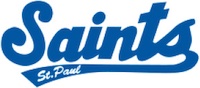
There's really not a lot to say about the current incarnation of the St. Paul Saints. The source of the name is pretty obvious, and the logo is about as generic as it gets. In previous reviews I spent some time discussing the team's then-president Mike Veeck and some of his crazier promotions, which played off then-current news stories such as Michael Vick's arrest for running a dog fighting ring or Idaho senator Larry Craig's arrest at Minneapolis-St. Paul International Airport for indecent behavior. But Veeck is no longer part of the organization, and the team's current promotions aren't nearly so colorful. So I did what I usually do when faced with a situation such as this and went looking for something interesting in the history of either the city or previous teams. What I found was the first team to go by the St. Paul Saints name, but more importantly, the clusterfuck of a "major" league they briefly played in. I'll go ahead and tell you that it'll be quite some time before we actually get to the original St. Paul Saints; in fact, it'll be a little bit before we actually get to the league in question. Because to understand that league, we have to understand the state of professional baseball back in the Nineteenth Century. So, without further adieu, here we go.
Baseball was the first team sport to be played professionally in the world. Well, let me hedge that a little bit. It was the first team sport to be officially played professionally in the world. Regardless of the sport, the first professional league usually came about because the practice of "amateur" teams paying players on the sly got so widespread that everyone involved just said, "Oh, hell, let's just admit what's happening." And while the first openly professional baseball league came about fifteen to twenty years before the first openly professional soccer league, it's not entirely clear if the under-the-table payments came to baseball or soccer first. In any case, the first team sports league to admit its players were being paid was the National Association of Professional Base Ball Players, founded in 1871.
When you're the first at doing something, you have no template to work from. You implement the idea as best as you can, inevitably find out you made a lot of mistakes, and fix them as best as you can. So as you can imagine, the NABPPB was a bit of a basket case. It's not their fault, really: like I said, they had no template to work from. But some of the problems they (and the other leagues that sprang up soon after) faced are absolutely unimaginable today. Teams floated in and out of the NAPBBP, sometimes midseason. I don't mean they'd fold midseason, I mean they'd just decide they didn't want to be part of the league anymore and they'd leave it. They'd schedule games against non-league opponents — not pre-season exhibitions like you sometimes see today, but in the middle of the season, perhaps when they were supposed to be playing a league opponent according to the schedule. And like the pirates in that Disney movie, they tended to regard league rules more as suggestions. They could do this because the league, having failed to anticipate what happens when you don't give a league much authority over the individual teams, didn't give itself much authority over the teams. Eventually most of the better-run NAPBBP teams got so fed up that they left en masse and formed the National League of Professional Base Ball Clubs. The NLPBBC was more centralized and more organized. And this move clearly worked, because the organization is still around. It's what you know as the National League. Officially the league's name even today is the National League of Professional Baseball Clubs, with the only change being that "Base Ball" became "Baseball". But while the NLPBBC was definitely a step up from the NAPBBP, it still had some growing pains to experience in those easy years.
This early on there was no real concept of "major leagues" and "minor leagues" yet, but the NLPBBC (I'm not certain why I don't just write "NL"; I think it's because I'm just so amused by the long-winded name) was clearly different from the other leagues. Most leagues were very geographically compact and had some teams in pretty small cities. The NLPBBC stretched from New England to the middle of the country, and all of the teams were in major cities. It was also understood that the NLPBBC had the best quality of play because it had the best players. This supremacy would get challenged in 1882 with the formation of the American Association of Base Ball Clubs. The AABBC, like the NLPBBC, stretched from New England to the center of the country. It mostly stayed out of cities that had an NLPBBC team, but there were still plenty of large cities to choose from. In fact, most of them were former NLPBBC cities, because when the AABBC started there were already more former NLPBBC teams than current NLPBBC teams despite the league being only six years old. (Like I said, instability is a recurring theme at this stage). The NLPBBC quickly (if grudgingly) accepted the AABBC as a worthy rival, and in fact the two leagues' champions would soon start playing in an early version of the World Series.
But then someone said Wait a second, if we can have two big leagues why can't we have three? That someone was Henry Lucas, a millionaire from St. Louis. Lucas had just formed his own team, the St. Louis Maroons, and he wanted the Maroons to play in a big league. The AABBC already had a team in St. Louis and thus wasn't about to let the Maroons join, and the NLPBBC wasn't interested, either. So he rounded up owners in other big cities and formed the Union Association of Base Ball Clubs. Like I said, the AABBC and NLPBBC mostly stayed out of each other's cities, but the UABBC had no such compunctions. Why should it, when the whole point was that it was founded by someone trying to put a second team in an AABBC city? In addition to St. Louis the AABBC had teams in Brooklyn (still a separate city from New York at this point), Baltimore, Washington, Pittsburgh, Columbus, Toledo, Cincinnati, Indianapolis, and Louisville; the UABBC put teams in Baltimore, Washington, and Cincinnati. The NLPBBC at this point had teams in Boston, Providence, Buffalo, Cleveland, Detroit, and Chicago; the UABBC put teams in Boston and Chicago. Both the NLPBBC and AABBC had teams in New York and Philadelphia, and the UABBC decided Philly could use a third team. In short, the AABBC may have competed with the NLPBBC, but did so mostly from a distance. The UABBC got in both of their faces.
Careful readers may note that this gives the UABBC only seven teams: Boston, Philadelphia, Baltimore, Washington, Cincinnati, Chicago, and St. Louis. Of course, even back then baseball schedules were such that leagues needed to have an even number of teams. So to get that eighth team, the UABBC added a team in the massive metropolis of...
Altoona, Pennsylvania.
Now, I should perhaps clarify one thing here. You might look at the lists above and think the other two leagues had some teams in small cities, too, what with Toledo and Louisville having teams. But no, those cities were relatively bigger back then (Louisville was actually bigger than Detroit, for example). But Altoona didn't even crack the top one hundred cities by population. Basically, Lucas needed an eighth team and wasn't in a position to be picky. So he convinced the owner of Altoona's team in the Inter-State Association of Professional Base Ball Clubs (a predecessor to today's International League) to join the new circuit. How did Lucas do that? By convincing the Altoona team's owner that his team would gain some additional backing from a railroad in the area that would help the team be profitable and competitive.
This was, to be clear, a lie.
The backing from the railroad never happened. And Lucas had no interest in the Altoona team being competitive, or any of the other teams for that matter. He had connived to make certain his team had the best talent in the league. The league was so imbalanced that to this day the 1884 Maroons arguably have the second-best winning percentage in the history of major league baseball. (I say "arguably" because not everyone agrees that the UABBC should be counted as a major league. In fact, most people who know enough to have an informed opinion say it shouldn't for reasons that will soon become clear.) As for the Altoona team, it lost its first eleven games (it didn't help that their first several games were against the Maroons), went 6-8 in their next fourteen games, and folded. Attendance figured are obviously spotty for a league from nearly 150 years ago, but according to reports in the local newspaper some of their home games had only 200 or so fans in attendance. Only 200 fans? Yeah, I see why a lot of people say this wasn't really a major league.
When Altoona folded, the league hastily formed a new team in Kansas City to replace them. But the fun was just beginning. In August, the Philadelphia team, suffering from the double whammy of being both the newest and the worst-performing of three teams in that city, gave up the ghost. This time, the UABBC decided to lure an existing team to join midseason rather than form a new team. The Wilmington, Delaware team in the Eastern League of Professional Base Ball Clubs had already clinched the league title despite it only being mid-August, so the UABBC invited that team to join and take over Philadelphia's schedule. The Wilmington team probably thought that after dominating the ELPBBC so thoroughly, they could compete in a "major" league, so they accepted the invitation. There was just one problem: the players felt that since the team was in a different league, their contracts were no longer valid, and about half the starting lineup left and signed with other teams.
But wait, there's more. The team in Chicago was struggling financially, and just three days after Wilmington joined the league the Chicago team moved to Pittsburgh in hopes they could survive there. Then Wilmington, having only won two out of eighteen games, folded about three weeks after that. And about one week after that, the Chicago-no-Pittsburgh team folded as well.
It is now, dear reader, that St. Paul finally enters the picture. With Wilmington and Chicattsburgh having folded, and with St. Louis having already clinched the pennant (yes, they clinched with over a month left in the season), the league could have simply dropped from eight teams to six, juggled the schedule a bit, and hobbled to the end of the season. Instead, they lured two more teams. The Northwestern League of Baseball Clubs had collapsed in the middle of the season, and the UABBC invited the teams in St. Paul and Milwaukee to finish out the season.
I've been avoiding referring to the teams by nicknames thus far, because at this stage nicknames were very unofficial and teams often had more than one. But I will note that one of St. Paul's nicknames was the Saints (another, should anyone care, was the Apostles). They were thus the first team to be known as the St. Paul Saints.
Life in the UABBC didn't go well for the Saints. They played eight games in the remainder of the season and won only two. On the other hand, the Milwaukee team (and yes, they were called the Brewers) went 8-4, despite being from the same league. Let the record show that absolutely nobody regarded the NWLBBC as a major league, so the fact that the Brewers did so well in the UABBC is another argument that it wasn't nearly as major a league as it wanted to be.
So the first UABBC season has completed. We've seen one team relocate, four teams fold, and the commissioner-owned team clinch the title with over a month left in the season. You may be thinking to yourself: if this is how crazy the first UABBC season was, what must the second have been like? And the answer is simple: it wasn't like anything. Lucas, having dominated the league so thoroughly, convinced the NLBBC to let his team join. The other owners quickly lost interest. When a scheduled UABBC meeting convened in January, the only teams to actually show up were Milwaukee and Kansas City. Unsurprisingly, they decided to disband the league. That was the end of the UABBC, and of the first team known as the St. Paul Saints.
(A brief side note: Things didn't go well for Lucas after this. The AABBC team in St. Louis was dominating that league, and the Maroons were not nearly so dominant in the NLPBBC as they had been in the UABBC. Lucas basically squandered his fortune propping the Maroons up. He wound up working as a railway clerk a few years later. When he died in 1910 at the age of 53, one headline read "Famous Sportsman Who Spends Millions in Fruitless Baseball War Dies in Poverty".)
For the next decade or so there would be several attempts to put another team in St. Paul. Mostly they only lasted a year or two, often because they were part of a league that folded. Finally, in 1895, the Sioux City Cornhuskers, reigning champions of the Western League of Professional Baseball Clubs (note that "Baseball" is a single word here), were bought by Charles Comiskey and moved to St. Paul. Comsikey didn't just own the team, he also managed and played first base for the team. (I have no idea if this sort of thing was normal back then. It doesn't seem normal.) Unlike all of St. Paul's previous teams, this one survived.
Well, sort of. It definitely survived — it's still playing today (literally today...as I post this the first pitch is about three hours away), in fact. Just not in St. Paul. In 1899, the National League (now the only major league, as the AABBC had folded several years before) decided to dump four of its twelve teams, cutting loose the teams in Baltimore, Washington, Cleveland, and Louisville. The Western League decided this was a golden opportunity. Over the next two years it would put new teams in three of those cities (Louisville was the odd one out), then started putting teams in NLPBBC cities like Boston and Philadelphia. It also rebranded itself American League of Professional Baseball Clubs. Yes, that American League of Professional Baseball, a/k/a the American League. And Comiskey moved his his St. Paul Saints to Chicago to become the White Stockings, soon redubbed the White Sox.
Oh, and incidentally, do you remember the story about a major league team that decided in the 1970s to hold a promotion called "Disco Demolition Night" which ended with a bunch of drunken fans running onto the field and damaging it so badly that the second game of the planned double-header had to be forfeited? That team was the Chicago White Sox. And what employee of the White Sox came up with the idea for Disco Demolition Night? That would be one Mike Veeck, son of White Sox owner Bill Veeck. And yes, that's the same Mike Veeck who used to own the current incarnation of the St. Paul Saints and came up with the crazy promotions it was known for. Just thought I'd end this review by actually mentioning the current incarnation again, and this bit of trivia connecting the two teams struck me as the perfect way to do it.
Final Score: 82 points.
Penalties: Wordplay, 23 pts; Alliteration (egregious), 11 pts; Script,
7 pts; Obvious, 17 pts; Letter, 24 pts;
Bonuses: None.